Smart Glasses PoC: HXS Runtime Estimates 127% Longer Mixed Use
A selected wearable profile moves from about two hours to four hours 31 minutes, raising a practical question about software and the useful life of a session.
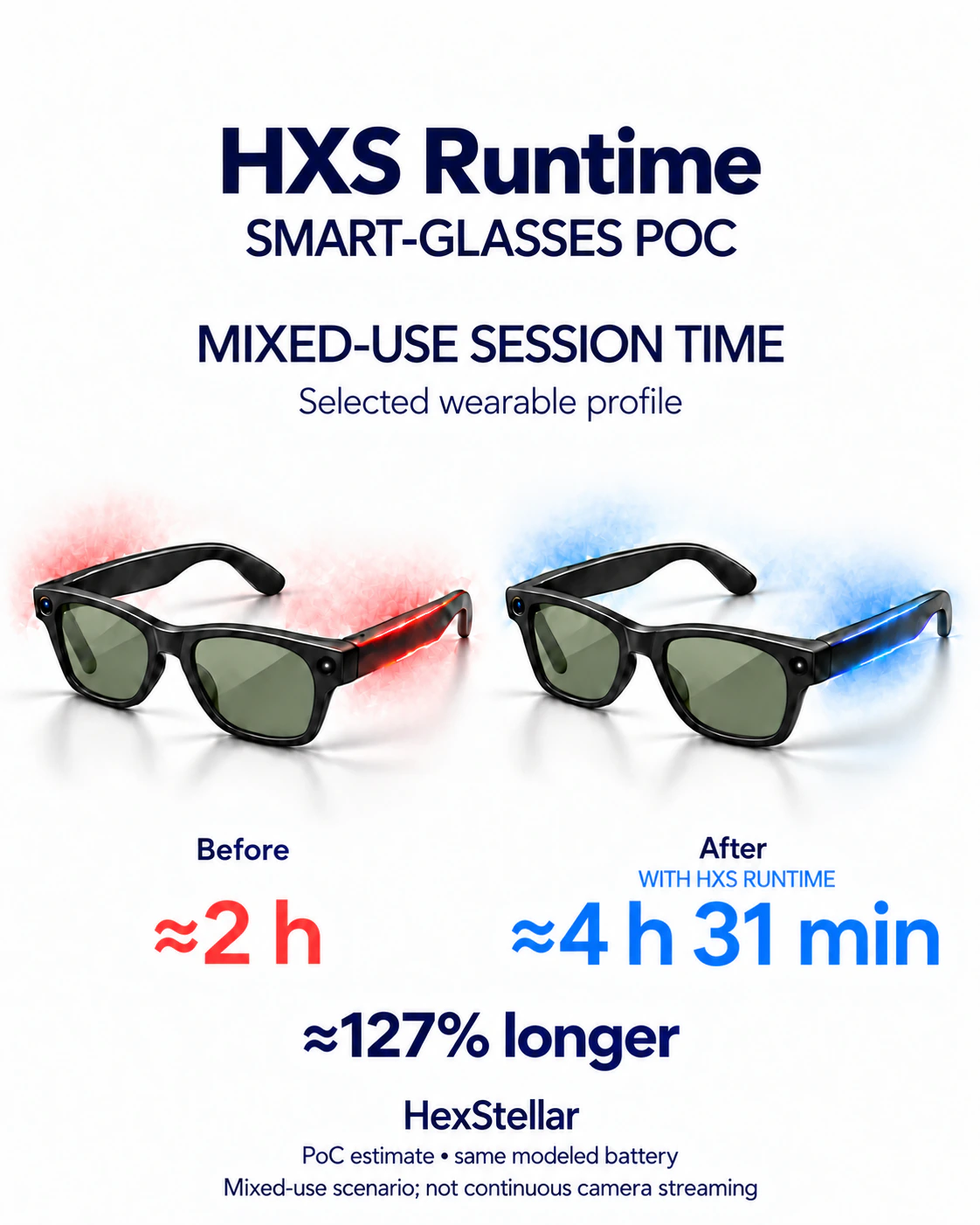
HXS Runtime’s selected mixed-use wearable estimate rises from about 2 hours to 4 hours 31 minutes—about 127% longer with the same modeled battery.
About two hours to four hours 31 minutes of mixed-use session time. That is the selected estimate in HexStellar’s HXS Runtime software wearable PoC, an increase of about 127% with the same modeled battery.
For a product builder, the opportunity is more useful time to complete an activity. If an advantage of that scale carries into an application, it could change which tasks a wearable can support and how much a person can rely on it through a working session.
This update focuses on one mixed-use scenario, keeping the duration, percentage, and infographic aligned with the same comparison. The company’s mixed-use estimate summary, checked October 24, 2026, provides the figures and their scope.
The selected mixed-use estimate
The historical comparison gives 1.994 hours before HXS Runtime and 4.518 hours with HXS Runtime. Rounded for the infographic, that is approximately two hours and four hours 31 minutes. The increase calculated from the unrounded values is 126.58%, presented here as about 127% longer.
| Selected wearable comparison | Original baseline | With HXS Runtime | Increase in session time |
|---|---|---|---|
| Mixed-use estimate | 1.994 hours, about 2 hours | 4.518 hours, about 4 hours 31 minutes | About 127% longer |
Source: HexStellar’s selected mixed-use estimate. Historical model dated October 20, 2026; checked October 24. Both sides use the same modeled battery.
The scope is specific: this is a historical generic wearable profile, not a calibrated Ray-Ban Meta (Gen 2) battery benchmark. Founder Brayon Pieske has separately identified Gen 2 as a device used in company testing; that device identity does not establish physical confirmation of this mixed-use pair. The figures above remain estimates for their declared scenario, distinct from measured retail battery life and camera-streaming endurance.
Why a longer useful session matters
A wearable application earns its place by helping someone finish something. Session length matters when it determines whether assistance remains available through the activity a person set out to complete.
Consider a hypothetical field assistant accompanying a researcher through a survey. The person moves between locations, asks questions, checks observations, and pauses to do work. An application that can support more of that session could make the assistant useful through an entire task, including the part that takes longer than expected.
That is the product consequence worth testing. A longer useful window could influence the activity a team designs for, the interruptions it expects a user to accept, and the confidence a person places in the application. The advantage becomes meaningful when it changes what someone can accomplish.
The selected comparison gives this possibility a scale. It also gives the next evaluation a clear target: establish whether a complete application can deliver the intended experience for longer under its own declared operating conditions.
Retail battery ratings answer a different question
Smart-glasses battery claims need the activity beside the number. Ray-Ban’s official Gen 2 FAQ lists up to eight hours of moderate use and up to five hours of continuous audio streaming and voice assistance. Meta’s Gen 2 launch announcement likewise describes up to eight hours of typical use.
Those manufacturer ratings belong to the retail product and the activities specified by the manufacturer. They provide useful purchasing context, but they are not a baseline for the generic profile in this PoC. Continuous camera streaming is another workload again; an audio-use rating does not establish its endurance.
Keeping those definitions attached makes the research easier to assess. The relevant comparison is between matching activities and conditions. A selected computation estimate and a retail moderate-use rating cannot be substituted for each other simply because both are expressed in hours.
Trust Carbon and the Meta developer context
Trust Carbon’s ongoing Meta glasses integration gives the wearable research a practical application context. It creates a reason to examine which tasks benefit from hands-free assistance and how long a useful session needs to last.
Meta’s introduction of the Wearables Device Access Toolkit described a path for extending mobile applications through glasses’ camera and audio capabilities. Its September 2026 developer recap describes Toolkit 1.0 as a stable, supported release, with mobile applications retaining their logic and backend while glasses provide a hands-free interface.
The official Android toolkit repository documents capabilities including video and audio streaming and photo capture. These capabilities make the complete experience an important unit of evaluation: the application, the activity, and the user’s working session all matter.
Trust Carbon’s integration work and the HXS Runtime estimate have separate roles in that discussion. The integration concerns an application experience; the selected estimate examines a possible session-time advantage. Bringing those questions together can help identify useful evaluations without implying Meta endorsement or an established endurance benefit for the integration.
A broader computing ambition needs evidence on each platform
HexStellar is continuing PoCs across several computing fronts. The broader ambition is to investigate where software can support more useful computation within an available resource budget.
That work also has a public record beyond wearables. HexStellar’s published GPU campaigns report measured energy, temperature, and serving-capacity outcomes on NVIDIA H100 hardware, alongside a separate request-level campaign. Those measurements and this wearable estimate are different evidence sets, each tied to its own conditions.
The research becomes more interesting as the useful outcome becomes clearer. For a wearable, the benefit might be completing a longer assisted task. On another platform, the important outcome could differ. Compatibility and advantage must be established for each application; a result in one setting gives the next question direction rather than answering it in advance.
What would make the opportunity real?
The mixed-use estimate points toward a concrete engineering proposition: a longer useful session could become a product advantage if it holds under the requirements of the intended application.
The next valuable evidence would connect that session to a defined task, a declared device and application, and a duration a person can experience. That would help a builder decide what to attempt and help a user understand what to expect.
The ambition is broader than one wearable profile, but the route forward stays concrete: test a useful activity, report the conditions, and establish whether the benefit carries through to the experience.
What would you build if more of a useful task fit inside the same energy budget?
Questions this raises
- What does the HXS Runtime mixed-use estimate show?
- For the selected generic wearable profile, estimated mixed-use session time rises from 1.994 to 4.518 hours, displayed as about 2 hours to 4 hours 31 minutes. The increase is approximately 127%, with the same modeled battery within the comparison.
- Is this a Ray-Ban Meta Gen 2 battery-life benchmark?
- No. The historical comparison uses a generic wearable profile that was not calibrated to a specific retail generation. The founder’s separate identification of Gen 2 as a device used in company testing does not establish a measured mixed-use result for this comparison.
- Does mixed-use session time mean continuous camera streaming?
- No. The figures describe the selected mixed-use computation scenario. Retail moderate-use battery ratings, continuous audio and voice use, and continuous camera-streaming endurance are different metrics with different activity definitions.
Discuss the Runtime research
Contact HexStellar with questions about this research or a scoped Runtime evaluation. An evaluation should define its workload, environment, measurements, and verification criteria.